Peru and Bolivia 2018 


     As the one year anniversary draws near my heart can't help but reflect on this time last year.
A year ago I was preparing for a two week, solo trip to Peru and Bolivia. "Why?" Everyone asked. The only thing that has ever felt remotely okay for the anniversaries of my Dad's birth and death is to be traveling. I wanted mountains and a coast, I wanted two places, and I wanted to see the Salar de Uyuni or the salt flats in Bolivia. There were other things that made the trip feel like destiny: I would be leaving my 20s behind just a few months after the trip ended, and I was feeling so connected to the idea that the there had to be life outside of the horrendous episode of depression I'd been in for a while. I'd really like to share my trip experiences with you, reader. One year later I finally feel ready to share the magic and heartbreak that this trip was for me.

    The trip was, to date, one of the best experiences of my life. I don't say that casually, my life has held so many good moments. The trip is still easily top 3. I remember so much of it with such fondness I feel my chest ache. I made the decision to travel in January and within a few hours settled on Peru and then Peru and Bolivia. I spent the next 8 months planning. I planned incessantly, researched bus routes and hostels, backpacks, shoes, cures for altitude sickness, vetted tour companies, and read blogs. I made spreadsheets and budgets and started working an additional shift on Sundays to cover the cost. From January to August when I was feeling hopeless or lonely I planned. The trip was good for me before it ever happened.

   While I'd traveled solo many times it was always domestic, and my international travel was fun but very passive on my part. Someone else did all the planning and had all the responsibility.  I had to do a lot of work on myself to be ready for this trip. When you travel you are surrendering to the universe, you have so little control. Will the airline lose your bag? Will strangers be kind when you are lost (and you're naive if you think you won't get lost)? What if you get sick? What if you lose your passport? What if your flight gets cancelled? I had to surrender and trust that it was all going to work out. When anxiety crept in, I would say in my head "just trust it's all going to work out and let go." And so, with that in mind, and 6 pairs of leggings, 6 shirts, and a small stash of toiletries and art supplies on my back, I was off to Lima. One cancelled flight, one missed flight, and one new friend later, I arrived in Lima after midnight on a Friday night.

  For my Dad's birthday I bought a ticket to take a boat tour of the Ballesta Islands off of the coast of Paracas, Peru. I love boats, and water, and he did too. The islands were amazing and so was being on the water. I just wanted to be close to him that day. As expected, being gone on his birthday helped. I can't fully articulate my feelings on the subject yet but basically I promised him that I'd be fearless, that I'd chase my dreams with such abandonment of all inhibitions and certainty.  His birthday reminds me of this promise, and being far away at that time makes me feel like I'm living up to it.


     By the end of the day I really hit my stride as a traveler. I spoke english only to translate for those that didn't speak Spanish or to write in my journal. I engaged others in conversations and spent my time writing in my journal and drawing. No one had asked me about the current political leaders in the U.S. and I adjusted easily to the higher altitude.

   One distinct part of the trip was the 30 hour bus ride between Huacachina and Cusco. In terms of distance these cities are about half that amount time from each other, but they are separated by the Andes Mountains. So, one must go around if one is traveling by bus. Think traveling from STL to KC but not being able to drive through Missouri. Or, for my southerners, like going from Charleston to Birmingham without going through Georgia. Anyway, the bus ride was actually one of my favorite things. The seats on the bus are comfy and convert into beds that lay nearly completely flat. Of course I slept at night but during the day I listened to podcasts and looked out the window. At one moment during this, life felt perfect. All things painful and tedious were literally a continent away, and not a soul in the world knew exactly where I was. I was unfindable and thus fully connected to the present moment. And the present moment was my favorite podcasts, the most breathtakingly beautiful scenery I had ever seen, and the warmth in my chest signaling peace and elation. That moment, to me, is what I live for. Those are the moments I chase.


   The one downside to the bus ride was that barreling through the country with nothing longer than a 30 minute stop every so often was that there was almost no time to acclimate to the altitude and many people on the bus got quite sick. What had felt to me like a rowdy, enthusiastic bunch the day before was suddenly a silent, slow-moving group of people who looked like they'd just woken up from the deepest sleep of their lives.  I chewed the coca leaves I'd bought and rubbed lavender oil all over my face and hands. The taste was awful but I imagined moistened particles of the leaves absorbing into my body and for about ten minutes I had to focus fiercely on not throwing up. Fortunately the combination of coca leaves, lavender, and a real meal did the trick and I was feeling fine again within the hour. My shower and subsequent slumber in Cusco the next night were among the best of my life.

   Due to some circumstances I still don't understand, I ended up having a private driver drive me the 2 hour drive from Cusco to Ollantaytambo. Ollantaytambo is the town you need to get to in order to take the train to Machu Picchu. Unfortunately, the main route was under construction so the driver had to take back roads through some small villages. The driver, a very sweet and courteous gentleman, didn't know exactly how to get to Ollantaytambo taking the back roads so every few minutes he'd stop and converse with the locals. For the first time, I couldn't track what was being said around me. We were in a part of the country where the residents speak the indigenous language, Quechua. The driver told me about his mother and how she didn't speak Spanish, she spoke Quechua. He told me stories of how good Quechua speaking people are and that because of them we'd arrive in Ollantaytambo without any issue. And he was correct. The experience of ascending and then descending the mountain and seeing the small towns and people working and going about their daily lives was really incredible. I felt so lucky that the main road was down and that I got to see a little slice of Peru I wouldn't have otherwise. I was silently grateful to the inhabitants of the small towns  for letting me pass through. I wish I'd tried to thank them.

  Here's an excerpt from my journal "We ascended a mountain and there was Cruzpata. Then we had to descend and that was Urubamba. Then we got to Ollantaytambo and I got on the train no problem. The GPS had us arriving at 12:40. I needed to be there at 12:25 for a 12:55 departure. Again, I just had to let go. It did work out. Of course it did. The prevailing message is that it's all going to work out."

  I learned that they don't call it the "Sacred Valley" (Valle Sagrada) for nothing. It just feels magical. Maybe it's the remarkably beautiful landscape. Maybe it's the sound of the river right next to the town, or maybe it's all of the anticipation and then satisfaction of being on the way to or from Machu Picchu. Whatever it is, it's real. The town of Aguascalientes is sweet and busy. The room where I was staying was on the second story and a street view window. I opened the window and listened to the town below as I wrote in my journal and sent some pictures to friends. I had promised to check in every few days so they knew I was alive.

 When planning the trip, I initially excluded Machu Picchu. I was in it for the salt flats and had a limited amount of PTO. Logistically Machu Picchu is difficult and pricey to plan. It involves getting to a city (Cusco) deep in the mountains from which you have take a 2 hour car ride to a town where you take a 2 hour train ride to a town where you then take a 30 minute bus ride. Because of the way that the tours work, and to avoid altitude sickness, all of those things have to happen over the course of several days. And then you have to do it all again in reverse to continue to your next destination. I told one of my few friends who knew about the trip that I wasn't doing Machu Picchu and her protest was so significant that I re-worked the entire trip to fold it in (which took several weeks, by the way). On this side of the experience, I can't believe I almost didn't go. Truly, what a loss that would have been. There aren't words to describe it, there really are not. It was stunning. Every where you look it's so sensational and heavenly it's like you are dreaming. I just wanted to freeze time and hold on to those moments and that feeling forever. It was worth every moment of stress and penny four times over. The top pic is the Sacred Valley, the rest are Machu Picchu.


I returned to Cusco to the same hostel I had been before Machu Picchu. On a trip where I was sleeping somewhere different every night, coming back to somewhere familiar felt like coming home. Here's an excerpt from my journal: "I'm back at the Sunset House Hostel today. I was ready to go back to my same bunk downstairs but my past self is a genius and I apparently booked myself a private room with a bathroom and TWO towels. Genius."
     I came and went from my adjoining bathroom pooh-bearing (wearing only a shirt and no pants) all evening like a queen. This was halfway through the trip and I was so happy but so tired. I was walking so much and there was markedly less oxygen in the air which didn't make me ill anymore but did exhaust me. The next morning would be the first morning that I didn't have to be somewhere early, and my last in Peru. Feeling refreshed, I took this clean hair, clean clothes (finally did laundry), no make-up selfie after sleeping in the next day.


   My whole last day in Peru I kept internally getting pulled back to feeling so grateful for being here and sad to leave. It was bittersweet, I was sad but also ready for the next leg of the trip. I visited a cathedral that was built in the 1400s and a pre-Columbian Art Museum that was really interesting and enjoyable. I kept thinking about my compulsion to be fearless and how that would likely often include leaving things behind. The next morning I was stamped out of Peru and into Bolivia which was it's own adventure. Bolivians, fairly, are not fond of Americans. I felt grateful that they granted my visa which was not guaranteed and I had to jump through some additional hoops to make that happen. I don't blame them. I'm just glad they eventually accepted my request to enter.

  Bolivia was breathtaking. It was just so incredibly beautiful. It was also very different from Peru. The differences between Peru and Bolivia are analogous to the differences in the climate of the two countries. Peru is on the coast, much warmer, much more friendly, at ease, and inviting. Bolivia is inland and cold, even during the day. The people move with purpose and are busy and not likely to pay you any mind. In Peru people expected me to speak english, but in Bolivia no one spoke to me in english. There was an expectation that one speak Spanish despite being a native speaker or not.  Despite Bolivia having a certain chill to it socially and temperature wise, the people that I struck up conversations with were friendly and helpful. My first several hours in Bolivia were along Lake Titicaca. After a full day of hiking and boat rides I took a long bus ride to the city of La Paz and checked into my first hostel eeeearly that morning. Here are some pictures that demonstrate my earlier point of breathtaking beauty:


  I woke up later that morning rested but feeling anxious. I could hear the city hustling and bustling beneath my top bunk and it just made me want to stay inside and stay away. I had conquered Peru. I had become confident there. But this was Bolivia, and I felt small and invisible here. I wanted to go back to Peru. Slowly, like watching-ice-melt-slow, I forced myself into the city and while still feeling very timid enjoyed wandering around. I window-shopped for gifts for friends but didn't buy yet so I wouldn't have to carry everything around. I bought some snacks for the bus ride that night as well as some bacitracin and other essentials.

 That night I boarded an overnight bus to Uyuni which was about 10 hours south of La Paz. I had dinner on the bus and watched some of the movie that they were showing. I don't know the name of it but the move was about these three dudes that get separated from each other hiking back from Machu Picchu. I thought it was interesting that they were showing a movie with a terrifying plot line to a bus load of tourists. The bus pulled over right before the sun came up. Not everyone took the opportunity but I bundled up and walked outside so I could watch the sun rise. If I had to describe Bolivia in only two words one would be "beautiful" and the second would be "cold." Like below zero cold.


    Later that day I met my fellow Salar de Uyuni travel mates: a couple from Switzerland, and a family of three (Mom, Dad, and son) from Venice. We met our guide, loaded up our luggage and took off. The couple from Switzerland spoke German, Spanish, and English. The husband in the couple from Venice spoke Italian, very decent English, and very limited Spanish. The wife spoke Italian, almost no Spanish, and very little English. Their son spoke Italian, very good English, and limited Spanish. Our guide spoke only Spanish. Making a group decision was quite the process. It was actually really fun. I enjoyed talking to the woman from Venice. It was somewhat challenging but with my Spanish proficiency, her english proficiency, and the overlap between Spanish and Italian we were able to figure it out.

  The Salar tour was three days and two nights and the first day was my favorite. That's the salt flats day. I first learned about the salt flats years ago. I saw a picture online of the mirror-image landscape that the salar creates and was mesmerized. That's when I decided I'd go one day. When I started thinking about this trip and settled on Peru I realized Bolivia was Peru's neighbor. And in Bolivia are the salt flats. Perfect.

  So the salt flats are a giant salt desert. The ground is white (you know, like salt) and during the wet season it will rain and the water won't absorb into the ground right away, it just sits on top. The water sitting on the surface of the white salt creates a giant mirror for the sky. I wasn't counting on having the mirror experience, as that most likely happens during the wet season which was months away at the time. I got so lucky, though. Just the week before it had snowed, and over the last few days the snow had begun melting. It took a few minutes to find but eventually we found about 2 inches of water proudly sitting on the surface of the salt. I couldn't believe my luck. It's insanely beautiful. Like that existential, how-is-this-even-planet-Earth beautiful. See below. You'll be able to tell which ones are pre-water discovery and which are post. Both are so lovely.


I went a little bananas and as took my shoes and socks off to walk around barefoot. I just had to. I was just at peace. The idea of putting socks on wet feet and then having wet socks in my shoes for the rest of the day made me pause for a second but ultimately I decided it would be worth it. I regret nothing. 


Another fun thing about the Salar (as if the above isn't satisfaction enough) is that you can take cool perspective photos. Our guide was very patient and kind to take these for us!


  Soon the sun began to set which was, you guessed it, gorgeous.


     We drove another hour or so to the accommodations for the night. It was a small hotel in a rural part of the country that's only accessed for tourism and related commerce. There were other tour groups arriving around the same time we did so we had to wait a bit to get checked in. The Italian family and the Swiss couple got taken to their rooms within twenty or so minutes, and then slowly everyone else did as well. I was tired and also didn't want to rush anyone so I took a seat on the far end of the room and waited there. So much time lapsed that I started to feel like something was wrong. Not only had a lot of time passed but I also hadn't seen any of the employees or the guide for several minutes which only made me more suspicious. Eventually a woman, someone who I had identified as a manager or owner, approached me and apologetically explained that the all the rooms were full and they did not have space for me. She asked if I would mind sharing a room with one of the employees in the linen closet. She told me she'd make me a nice bed and that the employee I'd be sharing with wouldn't bother me. She assured me it would be fine because we were both girls. I told her that that was fine and she scurried away, I assume to make my bed.

    I was crushed and began crying as soon as she left. I really didn't care that the hotel was over-booked or that I would have to sleep in a make-shift bed with an employee of the inn. I was reacting to the sentiment that there wasn't room for me. Her statement that they didn't have enough room for me instantly and enthusiastically released all of my inner demons of being too much for people, being a burden, and not being worth it. I cried as I felt pangs of anger over wondering what I paid for? It's not that I wanted a room, it's that I wanted to not feel like a burden. When you pay for something you earn the right to have or use it. I had paid so that I wouldn't have to bother anyone, and yet I still was. The scarf around my neck and my sleeves were soaked with tears and boogers. I was sitting in the corner of a large room that was full of people. I was simultaneously terrified that someone would see me crying and terrified that they wouldn't. To my relief and disappointment, no one did. Or if they did they didn't approach me. In the end, I'm glad for that. In the moment I felt so invisible.

   At some point the intensity lessened and I began to work on having a good attitude. I told myself that this wasn't a big deal, it happens. It will be funny one day. I thought through how this wasn't personal, it was circumstantial. It had noting to do with me as a person, it was just an unfortunate situation. I reminded myself of the amazing day I had, the extreme fortune that it snowed just last week leaving a fresh layer of water over the salt just for me. I thought of the excitement of the next few days and reminded myself that when you travel, you surrender. By the time the woman returned I was calm and just ready to get settled, wherever that may be. She showed me to a room where the walls were lined with shelves of sheets and bedding. There was a small bed in the corner that I don't know if it was actually a bed or just a lot of padding all on top of each other or what but I didn't really care. It was comfortable, warm, and seemed safe enough. She introduced me to the employee who's room this was. I smiled and said hello and she looked at me with what I perceived to be a very reluctant look. Instantly I felt ashamed and like I was a burden but I didn't know what to do.

   Later at the dinner table my Italian and Swiss mates asked me how my room was and if they eventually got a room ready for me. They didn't know what ended up happening and I lied to avoid telling them about it. I had a feeling that my travel mates, while well-intentioned, would have made a scene out of the situation and insisted that I be refunded or given another room or invited me into one of their rooms and I was just ready to move on. While I enjoyed spending time with them, my travel mates were more comfortable with using their power as a consumer than I was and less interested in peacekeeping. I just didn't think it would be worth it to share with them what was happening. I stand by that choice, but it also made me feel more invisible and like I had a secret which I really don't like.

  Even though I was now no longer upset about it and just ready to move on, somehow it still stung. And I couldn't help but feel inadequate and overlooked as a solo female traveler. I went to bed before my roommate and I made sure that all of my things were tucked away nicely and that I was taking up as little space as possible. She seemed so unhappy to have me in her room so I just wanted to try not to exist as best I could. I pulled my headband down over my eyes so that I could leave the light on for her and went to sleep.

  Looking back, I think if the woman had told me that they were overbooked and would I mind sleeping in a make-shift bed I wouldn't have gotten so upset. What got me was "We don't have room for you." I don't blame the woman at all, she was in an uncomfortable position. It just hurt to hear it that way.

  The next day we drove all over Bolivia and as the day wore on the situation from the night before faded. Bolivia has several lakes that are "colorful." There's the the green one, Laguna Verde and the red one, Laguna Rosada. Technically "rosado" is Spanish for "pink" but in this case it's referred to as the red lagoon in english and the pink one in Spanish.

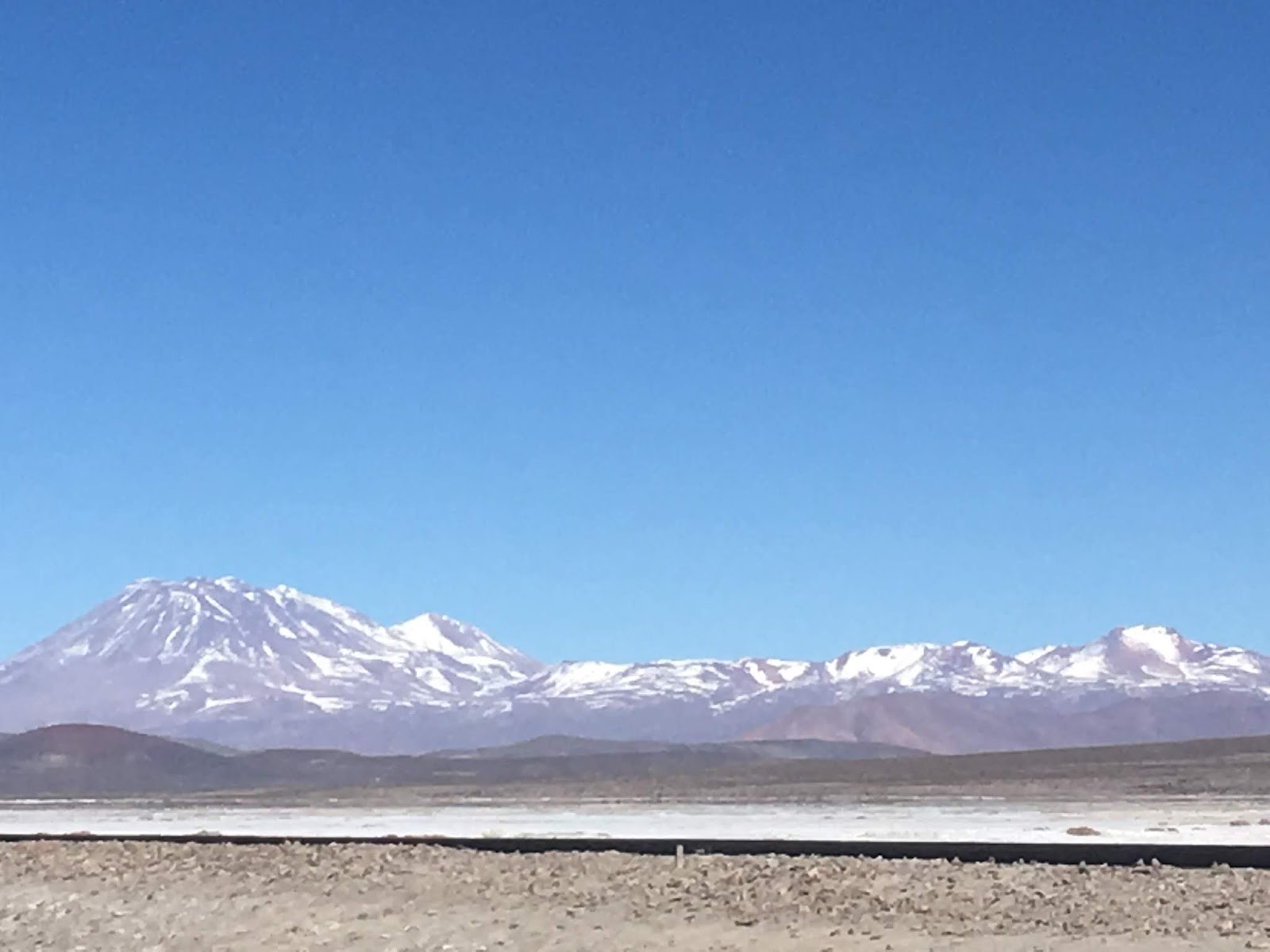

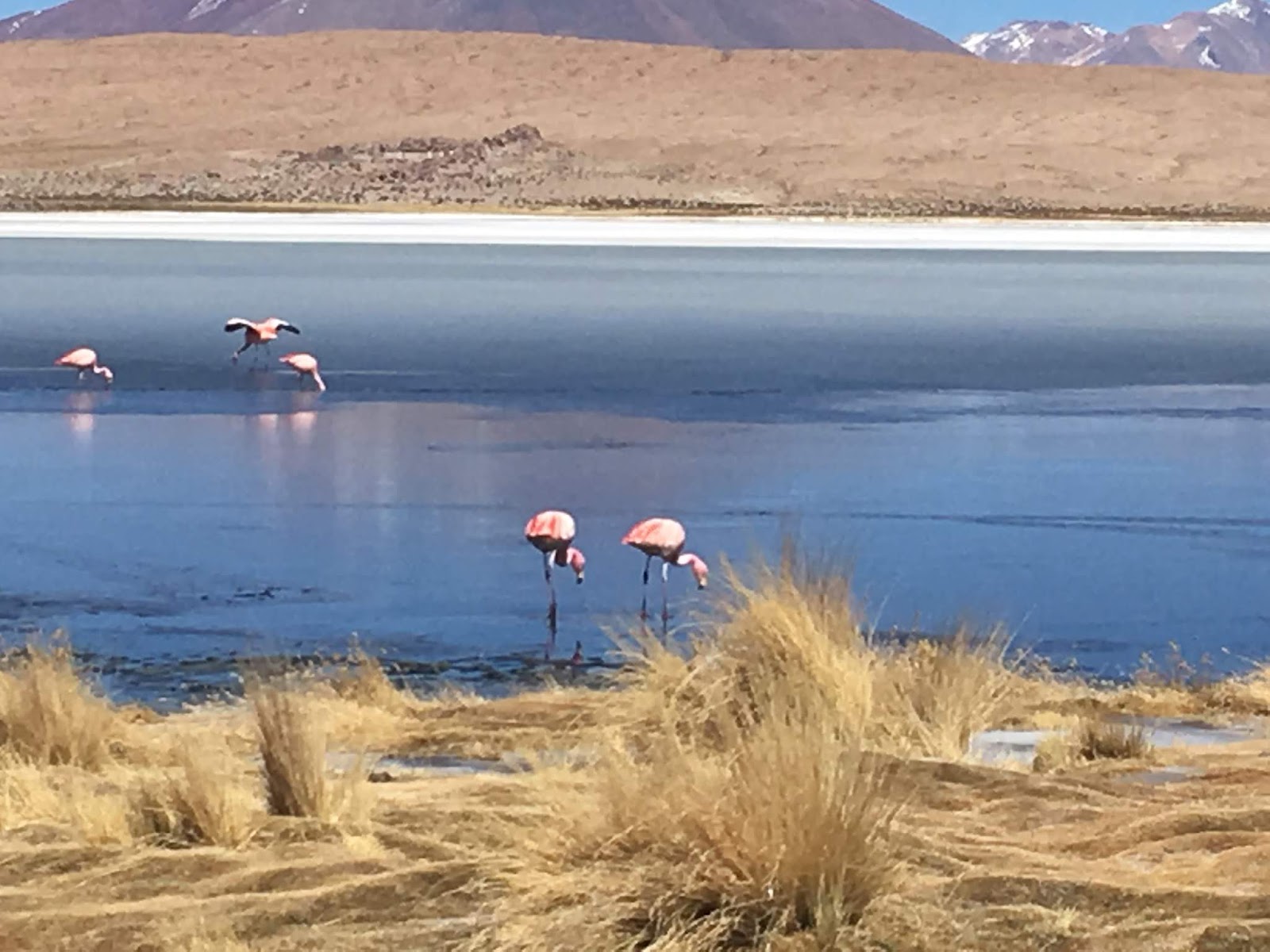


Day 2 ended with a long walk around Laguna Rosada. Our accommodations for that night were not too far so it was an easy adventure. The second night we were in an even more remote part of Bolivia than the previous night, nearly in Chile. There was barely electricity at the inn so we ate dinner by flashlight.
    I was really emotional that night. All I wanted to do was check-in via texting with a friend but the wifi was spotty and some of my travel mates were complaining quite excessively about that. Although I desperately wanted to talk to a friend I didn't want to make things harder for our hosts or come of as one of those obnoxious people that can't live without the internet. The inn did not have heat and it was insanely cold. Like, you-can-see-your-breath-inside cold. That night me and my two swiss friends were given a room that had about 10 beds. It was ironic to me that last night there weren't enough and tonight I could have 5 or 6 just for me. I somewhat shamefully removed the covers from 2 of the spare beds and put them on my bed because it was so cold. I put on two pairs of leggings, two shirts, my scarf, head band over my ears, two pairs of socks, and put a wool blanket totally over my face. I was not at all prepared for how cold it was. And at this point it was like 7pm so it was going to get way worse. My nose stung and bled on and off all night. I was really pretty miserable. I was so far away from everyone and all I wanted was to be close to someone. And I had to just get myself through it. I couldn't spiral or freak out, I had to just hold how I was feeling and ride the wave.
   I woke up the next morning prepared to go about my day in the clothes I was already wearing because there was no way I was removing any of them, even temporarily. It was way too cold to be shedding layers. I wrapped myself in my wool blanket and went to the table that way. When I returned to my room I grabbed the binder clip that I use to neatly store my phone charging cord and used it to clip my blanket on my shoulder as if it were a toga. I didn't care how ridiculous I looked, I was cold and this blanket was the warmest thing I had to wear. After breakfast was over I went around to all of the tables and emptied the left over hot water from the thermoses into my water bottle to keep my hands warm.
  Our car got stuck in the snow several times and several times we all had to get out and help push out. It was cold, dark, and miserable. I fell in the snow trying to push the car and instantly my legs were so cold. The moisture from the snow clung to my cotton leggings in milliseconds. Other tour guides kept stopping and asking if we needed help and our guide would respond "no" which I didn't totally understand but decided to trust him. After about an hour though of trying to get out and that not working I revoked that trust and approached an on coming car and asked him to please pull us out. He agreed and soon we were on our way. Also soon it was light out and much easier to go around the snow. The views later were worth it.


That night I was back on a bus to La Paz. I ate my dinner, changed into my jammies and went to sleep. Most of the nights of this trip I slept hard. Better than I do at home, actually. The next morning I was back in La Paz. I went back to the same hostel I'd been in a few days ago and got another bed. I wouldn't need it for too long, my journey back home would start around midnight that night but I wanted somewhere to leave my bag for the day and shower before my flight and all. The last several days I'd been winding down and knowing home was coming soon. I spent the day exploring La Paz and preparing to go home.

La Paz has a cable car system called the teleferico. It's to help improve the traffic and make it easier to get to the altiplano which is a higher elevation part of the city. La Paz is beautiful. I rode the teleferico around and just enjoyed looking at the city.


  I booked myself a hotel room in Orlando for the next night since I had a lengthy overnight layover. I made sure I had gifts for all my friends and made sure everything was packed correctly. I felt rested and was accepting of the fact that it was time to return home. Here's an excerpt from my journal: "I was worried about being the same person when I went home. I don't think that's the case. I've learned a lot practically and emotionally from doing this. I definitely feel rested."

 I struggled to come back home. I just didn't want it to end. I was very excited to see my friends, though. And tell them of my adventures. Also it would be nice to flush toilet paper and wear something other than my traveler clothes.

 Parts of the trip were devastating to me: the bitter cold and loneliness of wanting to connect with a friend but not being able to, the feeling of being a burden, the constant questions about how I could be so light skinned and haired and speak such perfect Spanish. Parts of it were also some of the best of my life: observing the most incredible scenery from my lounged bus seat while listening to Radio Lab, the spectacular view and magic of the salt flats, waking up in a different city every day feeling like the world was my oyster, the enchantment of the sacred valley and connection to the Spanish-speaking world I only feel while traveling.

  I am so grateful and privileged to have had the opportunity to take this trip. It did my soul so much good. I feel so relieved that I didn't cave to the pressure of not taking this trip and living a smaller life. It gave me these amazing experiences, and the knowledge that sometimes there's going to be pain because when you travel you surrender, and when you surrender you are vulnerable, and when you are vulnerable things can hurt. And they can also feel incredible. In general we all are our own worst critics and I am no exception. And not to brag or anything but I am especially skilled at being self-critical and indulging thoughts of self-hatred. But even I can't deny that with this trip, I was fearless.


Labor Day 2013 


     Kate and Sam didn't seem to see him, or maybe it just seemed that way since they were talking to each other. A man in a white t-shirt wearing sunglasses was kneeling on one knee, he was red, sweaty and breathing heavy. I couldn't blame him, so was I. August in Georgia is no joke. Temperatures are in the high 90s, humidity in the high 80s. And on this mountain that we are hiking there is very little shade. A smaller man in a flannel print shirt was not far from the man kneeling, he was obviously with him. And an older-than-the-others man, maybe in his late 40s was nearby on the phone. Kate and Sam were just a bit past the three men, but I felt like I couldn't keep going. "Do you need some help?" I asked. "Do you need some water?" I offered my purple camelbak eddy, and Sam and Kate offered their water bottles too. The man in the white shirt was in distress. He was sweating buckets and went from red due to the heat to pale from the heat in just a couple of minutes. His eyes were open and I caught his gaze, but he didn't seem able to talk. 
     I turn to the man in the yellow. "Are you calling 911?" 
    "I'm trying to." He said, a bit bewildered. 
     "Calling 911 from your phone won't be fast enough, you have to call from an emergency call station." I know this because my first job as a teenager was inside the very park where we are all hiking. Sam and Kate volunteer to run down the call box we passed on our way up the mountain. Sam drops her small bag with all of our keys and wallets and together they take off down the mountain to the call box and the man in yellow disappears. I realize he isn't with the other two men, he just stopped to help like we did. 
    I get closer to them. "Is there anything I can do to help?" The man in white is now sitting flat on the ground. He's very pale, very sweaty, and still out of breath. 
   "I'm not sure what to do?" Flannel shirt says. I sense his nervousness. 
   "Then I'll just wait with you," I say. "They'll be back soon." Poor guy, I think. It's super hot out here, he probably just over did it and he's over-heated and dehydrated. I'm slowly inching closer and closer to him which I guess was just instinct, because eventually he does lose consciousness and start to tip over. I'm close to enough that I and his brother in law, flannel shirt, catch him and guide him to the ground gently. Somehow in that I end up sitting behind him with his head and shoulders in my lap. 
    Everything that happened after that is such a blur. When I think about it, it plays in my head like highlight reel, just snippets of moments but never a coherent narrative of what happened. Things escalate quickly once he loses consciousness, and while I don't know what's going on I'm no longer assuming it's dehydration and over heating, it just seems more serious. Where are Kate and Sam? Did they call yet? Are the paramedics on their way? A small crowd of on-lookers has gathered. I'm mostly trying to block them out because they are only making me more anxious, but I let myself look over in search of Kate and Sam and anyone who looks like an EMT. I don't see anyone familiar or anything helpful, just lots of concerned faces. 
     "If everyone could just back up, please." The brother in law says. He's obviously a meek and gentle man, I can tell he was uncomfortable making that request. I can tell that he didn't mean me or the other two people who are trying to help, he meant the people crowding over who are just looking and not doing anything else. 
    One person is removing the unconscious man's shoes, and instructed me to remove his hat. "We need to let all the heat we can out of his body." Makes sense, I think. If nothing else it's something to do when we all know we can't do much. I'm trying to open my water bottle with my right hand while I hold the unconscious man's neck with my left. It's almost impossible to screw off the top. Someone sees me struggling and takes my water bottle, unscrews it, and hands it back. "Thank you." I say. I gently pour the water on the man's head and over his forehead. When my water bottle is empty someone else starts pouring theirs. I very gently, because of my long nails, sweep my forefinger under each of his eyes where the water has pooled. I do this several times. 
     We start CPR. The man doing compressions asks flannel-print what the other man's name is. "Chip" flannel-shirt replies. 
   "Okay, Chip. You stay with me now." Chest compressions guy says. He stands with one leg on either side of Chip's legs, places one palm over the other on Chip's chest and leans all of his body weight into compression after compression. Chip is tall with broad shoulders, and chest-compression guy is short and thin. Chest compressions guy is basically doing push-ups on "Chip's" chest. I pull gently on his neck and tip his head forward just slightly to straighten his airway as someone leans across me to breath for him. I can see Sam and Kate in the crowd now, and somehow that's a relief. It wasn't even a relief because I know they've called 911 and are back, it's a relief that I'm not alone. The look on their faces, even with sunglasses on, tells me it's bad. "Come on, Chip. Stay with me, Chip. Let's do this, Chip. Here we go, Chip." Chest compressions guy says over and over and over again. He does 10 compressions, the other man leans over and gives breaths, and it starts all over. "Let's do this, Chip. Here we go, Chip." 
    "Chip's" sweat is dripping on my legs. The tips of my fingers are touching each other on the back of his neck and his head is resting against my forearms. My hamstrings and calves feel like they are on fire from squatting in this position. I'm holding this man in my arms, looking into his face and literally praying to Jesus  to save this man's life. I don't let myself consider that he is dying or died, I only let myself think that if I have enough faith in God that he will live. Scripture that I've memorized floods my head. I'm calling upon it and shouting it at God in my head as if it's some promise that he must save this man. 
Psalms 37- the lord gives us the desires of our heart. Romans 11:1- I ask then, does god reject his people? By no means! Hebrews 13:5 For he himself has said I will not in anyway fail you. I look over into the crowd wanting to see Kate and Sam again and out of my proreferral  vision I can see a woman extending her arms in prayer towards us. Her eyes are shut tight and her lips are moving gently. For some reason it calms me to see I'm not the only one praying. 
   My thoughts are going back and forth from trusting god to demanding that god save this man to believing he will to not letting myself have doubt. My body is so connected to this man. I imagine life flowing through my hands and forearms and into him. I picture it pushing blood through his vessels and oxygen into his lungs. "Chip's" face becomes even more pale, he's now white was his t-shirt. And then within a few seconds it's purple. His lips are purple, his cheeks are purple. That's not a good sign, I think. But nevertheless I won't let myself consider that this man may die today, he may even be dead already. 
   The crowd starts to shuffle. EMS is finally here. It's taken them so long (it feels like) that I'm not even relieved to see them, I'm frustrated. In fact, I'm a little upset that they are here. Because now I have to move, I can't hold him anymore. I have to give him over to the paramedics now. I questioned if they could care enough to save him. Not because they did anything to earn that question from me, but because I'm so invested in this man living that I doubt anyone is more invested than me. 
   I'm last the person to get up and let the paramedics completely move in. Partially because I can't get up until someone else supports his head, and partially because I'm going to wait until the absolute last second to move. The paramedics hold his shoulders so I can slide out from underneath him. My legs are so sore, but nothing hurts more than breaking physical contact with him and walking away. I walked over to Kate and Sam. One of them hands me a water bottle. I stand with them and watch, and I start to cry for the first time in this whole ordeal. One of them rubs my shoulder. Flannel-shirt gathers up "Chip's" shoes and socks and the EMTs load him onto a stretcher. He has an oxygen mask on but no one seems to be moving quickly. The woman who had been praying approaches me. "Are you okay?" 
"Yes I'm fine." I say, obviously lying my ass off, and walk away. I feel a pang of guilt for being rude to her, my secret prayer partner. Even 4 years later, long after I've abandoned praying, I'm still so sorry for being rude to her, and it still stings. Before getting into the ambulance flannel-shirt finds me and hugs me. "Thank you so much" he says. I can tell he means it. I hug him back. "You are so welcome." In my head I say I didn't do anything. What kind of person would I be to keep walking?
   I don't remember what they did but Kate and Sam take care of me. Eventually we go home. It's the second weekend of the semester and I have homework to do, but I let myself just lay in bed. I overheard the paramedic tell flannel-shirt that they are taking him to Dekalb Medical. I call the emergency room there but they won't tell me anything since I don't know his last name. He's going to be fine, I say in my head. 
   The next morning I can't take it anymore. I need to know what happened to him. I call a friend who has a friend who works at Dekalb Medical. I tell her what happened, give her all the information I can, and ask her to find out if he's okay. "I'll find out for you," she says, "but are you sure you really want to know? Even if it's bad news?" I've thought about this. "I just need to know." I say. "I'll be upset if it's bad news, but at this point I just need to know." 
She accepts this. "I'll call you back," she says.  Hours later she calls back. He didn't make it, he died. Likely long before the paramedics arrived. All of the sudden the nightmare from the day before has bled into today and gotten worse. All of the sudden it hits me that I man I did not know literally died in my arms. The reality that my prayers didn't work, that CPR didn't work, that urging life through my hands and into is body didn't work, sets in. 
     All of this launches me into the deepest existential period of my life. I have so many questions: why did he have to die? Why did god abandon him? Why did god abandon me? If, for whatever reason that I will undoubtedly disagree with, it was his time to die, why did I have to part of it? Why include me? What was the point in my involvement? 

Labor Day 2017


      Over time I've learned to how to sit with not knowing the answer to some of these, and others I have found answers to.  Fortunately or unfortunately (it depends on the day), my relationship with my higher power never recovered from this. Processing through all of this has taught me a lot about myself. For example, I know now that no matter how high the stakes are or how scary something is, if someone is in need I won't be able to walk away. I just won't, even if that's what I wanted. It's just not who I am, no matter how bad the outcome may be. Somehow this makes my work with eating disorders make a lot of sense. The stakes are high, and yet here I am. Another example is that I learned that vulnerability connects me to others. Being in this situation with him forced me to act according to my deepest, most raw feelings: I want this man to live. And I will believe anything I have to to make that true. And even though he didn't ultimately live, bringing forth my most delicate thoughts is what we bonded me to him and allowed me to feel love for him. 
    Even with four years between this event and the present, I still think about that day, this man, our brief but profound time together, and his family all the time. This weekend they are on my mind. I wish I could find them and tell them that I'm so sorry their brother in law, son, husband, and dad died. And even though it sounds impossible because I didn't know him, I cared for him as I would have the people I hold the most dear, and in those moments I loved him as deeply as I've loved anyone. 


Thanks for reading, everyone. 


  Hi, friends! 
   So there has been a lot of hype about the Netflix movie To The Bone. If you haven't heard about it, click here to see the trailer. This film is about eating disorders, or more specifically, anorexia nervosa. Since I'm the friendly, neighborhood intersectional feminist as well as the friendly, neighborhood art therapist, I thought I'd watch it and give y'all my two cents. The three things I'm mainly going to look at are race, class, and gender. Additionally, I'll talk a little bit about successes and failures of the film as well as implications. And sprinkled throughout will be my thoughts as a therapist who works with people diagnosed with eating disorders. Obviously don't read this if you want to watch the film for yourself. I'm totally going to give away the ending so consider yourself warned! 

   Before I dive in I'm going to include some resources. If you or someone you know needs support due to dealing with an eating disorder, you are not alone. You can call the NEDA (National Eating Disorder Association) help line at 1 800 931 2237. If you aren't really a phone person (I'm not), NEDA has a click-to-chat option. Click here. Additionally, there is a crisis text line where you can text with a therapist. Text "start" to 741 741.

   So, just to start out let's be clear that all not eating disorders mean anorexia. This association makes people with other eating disorders pretty invisible. That's really not okay. The DSM-5 recognizes MULTIPLE eating disorders. The classic ones that everyone knows are anorexia and bulimia, but there is also binge eating disorder, feeding or eating disorders not elsewhere classified (abbreviated OSFED, equivalent to EDNOS, eating disorder not otherwise specified in DSM-IV), PICA, and avoidant/restrictive food intake disorder or ARFID, and orthorexia. For more information on types of eating disorders and specific criteria, click here or consult a copy of the DSM-5. 


 Race 
   Not surprisingly but not any less disappointingly, the film does a pretty terrible job in the race department. There are precisely 4 people of color and they are all in supporting roles. The roles are as follows: a Latina woman is a housekeeper (obviously), a black woman who is a therapist and has less than 3 lines, a black woman who is a direct care staff person at a treatment center, and a young black girl who is a patient at the treatment center. Of the seven patients in the treatment center, 6 are white and 6 are female. Let's be very clear here. Eating disorder are 13% of women of 50 years old (source) and a harrowing FIFTY PERCENT of girls of color (source). Do we see either women over 50 or women of color represented here? No! The one person of color with an eating disorder is a bigger black girl who has binge eating disorder. This is pretty racist. Obviously women of color have eating disorders and obviously they don't just have binge eating disorder. Anybody who is woke will recognize that it's not accident that the only black patient in the film has binge eating disorder. And the black person with the biggest role is a direct care staff person. Direct care are pretty low on the totem pole in a treatment center. God forbid the psychiatrist or primary therapist be black, latina, asian, native american, or middle-eastern. (The psychiatrist and primary therapist were both white, and the psychiatrist was, you guessed it: a white man). 
    According to NEDA (the National Eating Disorder Association), exact statistics on the prevalence of eating disorders among women of color aren't available due to our historically biased view that eating disorders only affect white women. Relatively little research has been conducted utilizing participants from racial and ethnic minority groups. However, analysis of the Minnesota Adolescent Health Study found that dieting was associated with weight dissatisfaction, perceived overweight, and low body pride in all ethnic groups (source). 
    All in all, looking at race in this film is disheartening to say the least. I'm not sure it's any worse than any other film made by white people but that's not really praise. Aren't we trying to do better? 

 Class 
    As NEDA has observed and many of us can attest to, it's not just rich, white women who have eating disorders. It's actually not just rich women, and not even just women. We'll get to the gender stuff shortly. Anyway, there's a societal perception that eating disorders only affect privileged women. This simply isn't true and it's harmful for at least two reasons that I can think of, and maybe others that I haven't thought of. Reason 1: What purpose does it serve to categorize something as only affecting rich, white women? Are they not worth saving? Are they not worth living without a disorder that ruins lives? Reason 2: If eating disorders are "rich, white woman's disease" what does that mean for men and people of color with eating disorders? Do they now have to bear the shame of having a mental illness but also have a "white" illness? Do y'all see what I'm saying? It's simply further stigmatization in general to continue to view eating disorders in such a limited capacity. Let me be very clear here: I fully acknowledge that white women have not only participated but initiated racism and stigmatization against women of color and I do not condone that. But the point is no one deserves to suffer, and we should all be aware of that and working towards de-stigmatizing all sorts of things to achieve a world without oppression. 

 Gender
    The one male patient in this film is white and also a ballet dancer. For the only eating-disordered male to be a ballet dancer is reinforcing a problematic narrative about males and eating disorders. By the one man being a ballet dancer the film is sort of suggesting that only effeminate men or men engaged in feminine things like ballet are vulnerable to eating disorders. This is just false. Many men with eating disorders are athletes but I literally have never met one that was specifically a dancer. One sport or active discipline isn't more susceptible to eating disorders then the other. This idea only shames men who have eating disorders. It's true that statistically more women are affected, but it's also more men than you might guess. In the United States 10 million men will suffer from a clinically significant eating disorder at some point in their lifetime (source). And we haven't even talked about men of color, who are there is exactly one study one that I could find. 
    Additionally, there are no gender-fluid characters in the film or even mention of gender fluidity. However, 16% of transgender college students are affected by eating disorders (source). 
    There are other things missing from the film too, such as people over the age of 25 having eating disorders, people with different physical abilities having eating disorders, etc. There's just a lot left out unfortunately. My point is eating disorders don't discriminate. And this film sort of makes it seem like there's a specific "type" which is false and dangerous. Let's be very clear about how dangerous eating disorders are: they are the most deadly of the mental illnesses (source). THE MOST DEADLY. You have a better chance of surviving depression, anxiety, schizophrenia, bipolar disorder, etc. This isn't to be taken lightly. Please understand that if you or someone you know is suffering with an eating disorder you don't have to bear that shame alone, and hopefully you'll learn you don't have to bear it all. Films like this are dangerous because they reinforce narratives that create barriers to people getting the help they need. 

    This is getting so long, you guys. But, if I'm going to do this I'm going to do it right. Here's what the film gets right and wrong about eating disorders: 

 RIGHT 
- Some people will need several rounds of treatment before they can live at home or in the community for an extended period of time 
- Eating disorders are not about the food - Having a severe, untreated eating disorder WILL kill you. The film actually holds this pretty okay. Not great, but pretty okay. 
- Some people will leave treatment because they aren't ready for it and return to it when they are. As long as they are medically stable, this is generally okay and can actually be good to get some perspective.
 - According to the white man psychiatrist "looking for one reason" that caused a person's eating disorder "is a losing battle. It's never that simple." I agree with this. 

 WRONG
 - People with eating disorders aren't going to see their body the way you might. In the film, the protagonist Eli has this sort of transcendental moment where she sees how emaciated her body is and it saddens her. She immediately goes to treatment after this experience. This is not real life. People with eating disorders DO NOT see their body they way others do. Trying to get them to see how thin they are is not going to work. Generally when a person with an eating disorder acknowledges that they were unhealthily thin it's after they've been in recovery for a good long while. Not being able to be realistic about your body IS part of an eating disorder, so people can't just see how thick or thin they might be and then want to change.
 - All the race, class, and gender stuff I already mentioned 
-"In-patient" does not look like living in a house with a staff person and other patients. That's residential care. True in-patient care is in a hospital.
 - In my humble opinion, it would never in one million years work to let patients choose the foods they will eat. Of course patients should have options and choices and as much autonomy as they can handle to pick their own meals, but it would not work to let them choose from literally anything and to agree to accommodate any requests. (In the film the rule is you can eat whatever you want as long as you are gaining weight). Those of us that do this work know how absurd this is. People with eating disorder severe enough to need treatment are not able to choose their own foods. Additionally, for their own safety and to ensure that nutritional needs are being met, they plan their meals with a dietitian. There were no dietitians in the film and they are a key player in eating disorder treatment. 

  Alright friends, I think that about covers it. Actually it doesn't, there's one more thing I want to write about but we'll call that part 2. Get out there and use your critical thinking skills as well as your compassion. 

 Much love,
 Veronica


Hello, everyone! 

 Yesterday I attended Mount Mary University's Spring Art Therapy Symposium and had such a great experience! I wanted to write about the things I attended and also just review the conference as a whole. Overall, this was a great conference. I feel like I learned a lot and I left all of the sessions that I attended just feeling really excited that this is my field. 

  Mount Mary's campus is gorgeous. It did make me feel like a kid in church since it's a catholic university so that was interesting but the buildings were really stunning. 


  My sweet friend K and I drove up to Milwaukee after class on Thursday (I love car trips so this was great!). We pretty much just talked the whole time. We stayed with a lovely family we found via Airbnb. Driving though Illinois at sunset was gorgeous. Even though I've lived in the midwest for a few years now I still can't get over the sunsets or just the sky in general, I've never seen so much of either before moving here. 


 Creative Collective Action | Holly Feen-Calligan | Keynote
   So Holly is from Detroit and her presentation was about service learning projects for art therapy students in Detroit and how participating in service learning is hugely beneficial to both the students and the organizations that participate. She was really interesting to listen to and kind of got my community arts brain fired up. Some research she shared that I put in my notes was "Service learning facilitates multicultural skills or intercultural experiences (Backos & Sanders, 2015) and contributes to professional identity. She shared a quote at the end that I loved, I didn't catch who she was quoting though. "Movements aren't born of critical mass, but critical movement." 

Art-Making as Resistance Against Oppression | E. Hlavek | Workshop

   This workshop was essentially about the presenter's research. She was in the doctoral program at Mount Mary. So her research was studying art work made in concentration camps and ghettos during the Holocaust. This was an extremely powerful and intense thing to hear about but it also felt really important. The presenter started out by sharing that there were 4 categories of cultural resistance against oppression and then talked about each one. The categories were resistance against annihilation, resistance against dehumanization, resistance against propaganda, and resistance against future genocides.  
  Elizabeth, the presenter, went through each of the 4 categories and we looked at artwork that was representative of each one. This was very interesting and also heartbreaking. In the first cateogory, resistance against annihilation, we mainly looked at portraits. Each portrait had a great deal of detail and line work that would have taken a very long time. They were intricate and graceful. The same detail was not at all present in subject's clothing though, which was curious. We talked about how the de-emphasis on the uniforms/clothing preserved personal identity. She said she found that people in the concentration camps and wanted to sit for portraits just to leave something behind that indicated their existence. Portrait work is 25% of all the artwork made during this period, which is an astounding percentage. It's the largest single category. The presenter quoted a museum in Israel where come of the portraits are housed: Portraits are "imbued with intense individuality and a dignity utterly denied to the sitters in real life." A Holocaust survivor who had a portrait done is quoted as saying "We want to be among the living at least on paper." Halina Olmucki
  Another thing Elizabeth shared that I did not know is that Edith Kramer, before coming to the United States, worked with a woman (I did not get her name) who worked with children making art in the Terezin ghetto. Coming from an immigrant family myself and just thinking a lot about that with the current political climate I love that one of the founders of our field was an immigrant and that she had roots in art making as care and resistance and preservation of humanity.
   The next part of the workshop we made art. It was essentially response art but she also gave a directive. I don't remember what it was because I didn't really need it. I was ready to just jump right in. Here's some photos of my art process. 


  So her presentation just made me think of trauma. I just thought about having something and then having it ripped up and having to put it back together. All of the pieces are there, but they'll never in the same order or exact spot as before. It's really a totally different piece. It resembles what it used to be in some ways but only in snippets at a time. The last step was writing on it. There was so much resilience evident in the portrait makers and sitters which I think we can all agree that resilience is a positive thing but they just should never have had to be that resilient. None of this should have happened to them. Looking at the art work that Elizabeth presented Bruce made the comment that this is kind of art work is happening in Syria at this very moment. That was really sobering for me.

   Lunch was a sack lunch type of thing, Sandwich, brownie, potato salad, sprite. Some people were whining about it but I thought it was nice not to have to leave for lunch and I'm used to AATA where lunch isn't provided and the closest lunch is $12.

Art Therapy Through a Trauma Informed Lens for Addiction Treatment | J. Albright | Workshop

   This presenter, Jennifer I think is her first name, was also a Mount Mary doctoral candidate and she was also really great. I've only known one person to go through Mount Mary's doctoral program but this conference made me see a lot more of what is coming out of that program which was really cool. Between this session and the previous one there's some pretty amazing work happening that will benefit us a lot as a field.
   This session started with Jennifer going through some light neurobiology and art therapy and also talking about 12 step groups and addiction treatment. Of course everyone in the room is at least slightly interested in art therapy if not an art therapist already so she didn't really have to pitch to us but one of the things that she said that I just thought was very succinct and useful was "art therapy helps with processing top down and bottom up and can be inserted wherever." Wherever people are functioning in their brain it can meet them there. Of course we all know this but her way of explaining it was really great. Art making can help with people who are just working at a sensory and kinesthetic level but also reaches people who are in abstract thought and higher order thinking really well. I knew I was going to like this presenter when she started talking about Bruce Perry, Bessel van der Kolk, and Katherine Skaife.
   Anyways, back on track, Jennifer spoke about how interconnected trauma work and addiction work are and how some complex questions come up when working with clients who need both. Examples of these questions where What if treating trauma causes relapse? What if not treating trauma causes relapse? and stuff like that. She also talked about steps 4 and 5 in the Big Book which are as follows: Step 4. Made a searching and fearless moral inventory of ourselves and Step 5. Admitted to god, ourselves, and another human being the exact nature of our wrongs. Jennifer said these steps are really reminiscent of trauma work. She also talked about how relapse was related to going through these step(s) without proper support after causes relapse and not going through them at all also causes relapse. It was really interesting.
  So in this one we used watercolors and first did a piece about our best day high or using. People who didn't have that experience were just supposed to imagine it or think of a client. I don't personally have the experience so I just tried to go off of what I've heard from others who have.

I just thought of this mental space where everything is right in the world, everything is beautiful, you're kind of floating with not a care in the world. You're like removed from all problems and issues and just able to appreciate the present moment that doesn't have any concerns in it. It's like a break from every day life. 

   We talked about these and the next part was paint (same materials) your worst day sober. This one was a little bit easier for me to be connected to.  Since addiction isn't part of my story as a personal experience I took this as "paint your worst day in recovery or your worst day with your mental illness or symptoms."


  For this one I just through of being on the floor. That was the first thing that came to mind, just being down. And everything being more real. Like the floor is real, table is real, the chair is real, the shining light is real. Like viscerally, tangibly, painfully real. And there's a glimpse of your best day in view (through the window) but you aren't super close to it. Even though this was a more difficult place and certainly a more unpleasant one, I still preferred this place to the first drawing. My thought this is uncomfortable and painful but it's certain, and I still prefer than the chaos of the first drawing. 
  We talked about these as well and looked at them together. We also talked about how to use this specific idea with clients and what the outcomes might indicate and stuff like that. I feel like I'm cheating you guys a little in not writing about all that here but I'm losing steam and still have one more section to add! If you are interested just email me or leave me a comment and I'll send you the rest of my notes from this talk. I left this session really excited and slightly more confident in both trauma and addictions work so that's awesome. It was a good feeling. 
  
   The last presentation that I attended was the one where I was presenting. Probably most of you reading this know the presentation because you've seen it but in case you haven't I was presenting a spoken-word dialogue that I wrote while I was in the process of working on my literature review or my research project (thesis equivalent). I interspersed snippets of my own story in narrative form with pieces of research that describe the experience of a wounded healer. 

  Immediately before the presentation I was freaking out. I think I was pretty collected on the exterior but in my head I was kind of losing it. I got really uneasy when I saw the room where I was presenting, it was essentially a chapel. It was beautiful. I wish I had asked someone to take a picture but that was not important at the time. So I asked for a volunteer, one volunteered and off we went. It went really well. I had it memorized but found myself looking at my paper just for comfort. I memorize it so that I can make eye contact with people as I'm talking but I've found that that gets intense and I need something a little more neutral to rest my eyes on in between meeting gazes. 
  
 I definitely am glad my support people were there. I had K, who I drove up with. S, a friend who graduated last year and now lives in Madison and came to the conference. And C, one of my art therapy heroines who I traveled to Africa with. I haven't talked to them about including them in my blog so I'm concealing their identities. Sort of, most of my readers are people who know all of them but still. I looked at them several times and just felt better with them there. It went really well. People had a lot of questions and I just tried to be really genuine and transparent and honest. I talked a bit about my research since there is some overlap but mostly people asked me questions or commented on parts of my story. It was pretty lovely. 

  After that, S, K, and I decided we were sort of conferenced out for the day so we went to get some dinner. There was one more hour-long session we could have attended but we were all pretty spent at that point. After dinner K and I went back to our Airbnb and pretty much immediately fell asleep. I woke up around 10:30 and did some homework and stuff and then went back to bed around 2. We woke up this morning and our host made us an awesome breakfast and then we hit the road. It was nice to drive during the day this time. The sun was pretty intense and we were quite warm but I am not complaining. 

  All in all it was an awesome experience. Congrats to Mount Mary for putting together a great conference. It was well organized and I loved all the sessions I attended. Also, thank you to them for letting me present. It was a great experience all around. While eating dinner S, K, and I all mentioned what a great conference it was and that we felt like we learned a lot for a one day thing. 

 I feel really grateful for my people and this community. I am so motivated to do everything I need to to finish school because I'm just really excited to keep on this path and be an art therapist. 

 Thanks for reading everyone! 


Emily rolled over in bed too quickly, bringing on a wave of nausea. She held her breath until it passed and then exhaled slowly. Breathing too quickly would bring it back. This was the eighth morning in a row of waking up this way. Emily knew she was either pregnant or dying and it was time to figure out which. In the bathroom she reached for a tan grocery bag on the bottom shelf that contained a pack of two home pregnancy tests. She bought them a few days ago but was hoping it would end up being a purchase made in vain. She followed the instructions, washed her hands and then waited. While waiting she didn’t allow herself to think about the “what if’s” she only focused on pregnant or not.  After the correct amount of time, plus thirty seconds for good measure, she peeked at the stick: two lines. Positive. Pregnant.  The second test she took came back the same. I’ve heard of false positives she thought, maybe I should go somewhere and do one of those tests just to be sure.
Back in her room she began looking for some clothes to wear. She settled for a maybe clean pair of jeans, definitely clean v-neck tee and her blue fleece. Walking through her living room there were remnants of several tasks begun but since abandoned; the deep-teal kitchen table held her transcripts and application for graduation, the couch several books she was supposed to be reading, and on the floor laid a large 6’ X 10’ stretched and primed canvas. So far her final painting as an undergrad was a white cow eating snow on a cloudy day. In the corner of the room there was a man’s ball cap. It was maroon and embroidered with VT for Virginia Tech, next to a signature scribbled in faded Sharpie. The sight of the cap drained the blood from her face and everything peaceful from her veins. She shoved it in the coat closet, under a porcelain white horse with a gold mane that, as a child, had always been on her dresser. It was one of those things that was a nursery decoration for a new baby and somehow had never been thrown out, boxed up, or given away.
Emily’s apartment was just east of downtown in progressive Decatur. She had heard there was a Women’s Health Center around somewhere and she knew they did free pregnancy tests. A quick google on her phone gave her the address of said center, as well as advertised free pregnancy testing at this location. While Emily was driving she wondered what the likelihood was of a place that offered free pregnancy tests operated by people who had taken a vow of silence. She really didn’t want to talk to anyone, nor did she want anyone talking to her. Just as the city was meeting the suburbs Emily followed a few small roads to her destination. According to her GPS she had arrived, but this didn’t look right. She was on a street with nothing but houses. This is a neighborhood, she said in her head. In the lawn of an old looking yellow house, she saw a sign that was barely bigger than the bushes around it that confirmed she was in the right place.
Emily breathed in a tense breath. She looked down at her abdomen. What will I do? She thought of Ben and anxiety filled her. Not able to sit with the angst, she left her car. Before reaching the front door of the little house, Emily reached into her pocket and slid her grandmother’s engagement ring onto her left ring finger.
Judging by the fancy camera doorbell Emily guessed this wasn’t the kind of place you just walk into. The huge lock and door knob made her uneasy; who were they trying to keep out of this place anyway? Emily rang the doorbell and someone answered through a speaker a few seconds later.
“Welcome to WHC, do you have an appointment?” the female voice asked.
“No.” Emily said. The website didn’t say anything about appointments. Emily’s thoughts came down hard. You should have thought to call and make an appointment, this is an agency. No one is going to believe you don’t need any help if you show up for a pregnancy test with no appointment. Great job handling this, Emily, really great job. As she was turning to leave, she heard the door click and unlock. Feeling so small, she opened the door and entered what she guessed was the living room when this was a house. It was probably a waiting room now. A petite young woman with blonde hair came through a door on the opposite end of the room. Emily became anxious as she realized that there were some holes in her five-second Google research via her phone.
“Hi, I’m Lindsey,” she said, putting a face to the voice from the speaker outside. Lindsey had honey-colored hair and green eyes. She was petite, just barely five feet tall. “What can we help you with today? Can I get you a bottle of water or anything? We have coke and diet, too.” She smiled eagerly and waited for Emily to answer.  
“No, I’m okay, thanks though.” Emily said, answering the easier question first. “I saw online that I could get a free pregnancy test here?”  
“Yep, that’s correct.” She said, temporarily relieving Emily’s anxiety. “We use the same tests that doctors’ offices use, and there is no charge. Did you want to take one today?”
“Um, yes, I do.” Emily answered. She felt like she was lying. She really didn’t want to. The question should have been “Do you need to take one today?”
“Okay no problem, I’ll let Liz know, she’ll be the one working with you. Just take a seat while I find her and get you some water, in case you need it for the test.” She smiled as she finished talking and exited the waiting room. Emily sat down on an old, dingy couch and began to absorb this house-turned-business. All of the furniture looked as though it crossed the line between antique and ancient a long time ago. The white walls were mostly bare, except for one with a few run-of-the-mill flower paintings.  Emily had a theory that there was one huge warehouse filled with ordinary flower paintings in dull colors where people who decorated offices always shopped. These were no exception. A few minutes later Lindsey came back in and handed Emily a bottle of cold water and a small napkin.
“Here you go! Okay, let me go find Liz and she will be right with you.” Lindsey said. Emily didn’t have time to say thank you before Lindsey was gone again, through a doorway on the other side of the room this time. Emily’s thoughts were pulled from orthodox flower paintings to what lay ahead. Soon her anxiety was the only thing in the room. The tension started to rise from her core again. She hoped it would be distracted with a sip of water. The cold water bottle clutched in her left hand made the ring on finger even looser. It rested on her finger at an angle, two degrees from droopy. Her hand looked like that of a teenage girl imagining her engagement with her mother’s jewelry.
A slender, red haired woman emerged from the same doorway Lindsey had just gone through. “Hi Emily, my name is Liz. Why don’t you come on back and we’ll talk for a minute while you finish your water?” Liz did not wait for Emily to answer her before she turned on her heels and lead Emily back to her office.
“Nice to meet you.” Emily said. She suddenly felt hurried and stood quickly to follow Liz around the corner and into a small office.
“Sit anywhere you like, Emily,” Liz said. Emily sat in the old brown chair closest to the door. There was a little end table next to it and another old brown chair on the other side. Liz sat in a comfy looking office chair across from Emily. “Lindsey mentioned that you came in for a pregnancy test...Is that right?”
“Yes,” Emily answered. She was starting to relax a little. Maybe she wouldn’t have to divulge information and details about her life she’d rather keep pushed away. Was it because of the ring? Or did they just want to get her in and out of here as quickly as possible like a doctor’s office? Liz certainly seemed like she had stuff to do.  
“If it’s alright with you, I have a few questions. It’s important to consider any reasons why the test may be inaccurate. If I ask you anything that seems too personal, please do not feel like you have to answer. Of course anything you say is confidential, and I won’t ask you anything just to prod. Okay?”
“Sure, okay.” She answered Liz’s awkward questions about cycles and contraceptives and it wasn’t long before she finished her water and was leaving a cup with her “specimen” on the counter in the bathroom across the hall. After washing her hands, she stopped to examine herself in the mirror. At first she saw a glimpse of a fairly pretty young girl who had peace behind her dark brown eyes and happiness wrapped up in her ponytail. But it was only a glimpse. She wasn’t that girl anymore. Her ponytail didn’t hold happiness, it held exhaustion, and behind her eyes there were only things she didn’t recognize. Angry with herself, she wiped her tears with her sleeve so hard that the skin around her eyes stung. She returned to the small office and saw Liz standing by her chair. Emily took her seat again.
“Let me run the test real quick and I’ll be right back, honey.” Liz said, leaving the room. Honey?  Emily didn’t have Liz pegged as the “honey” type of lady but it was Georgia after all. Liz came back a few minutes later and took her seat again. “It will take about five minutes to get the results.” She said. ” Emily, can I ask you a few questions about the father?” Liz said, paying no attention to the ring on Emily’s finger. Emily’s movements ceased completely and her insides tightened, her eyes stayed fixed on the last thing she had been studying. Without meeting Liz’s eyes, Emily offered an answer she hoped would end the conversation.
“He’s just an old friend.” She said dismissively, her body still tense. That was one way of describing Ben.
“Does he know that you suspect you are pregnant?” Liz asked,
“No.” Emily crossed her legs and her arms in front of her. Liz was starting to cut a little close.
“Do you plan to tell him the results of the test?” Liz asked. Just then, the timer dinged. Liz rose from her seat, excused herself and went back to the bathroom. Emily was slightly relieved at being released from answering this question, but she knew she was not in the clear yet. There was the bigger question of the fate of her womb still in the air.
  Her thoughts wandered to Ben, the man she hated to love.